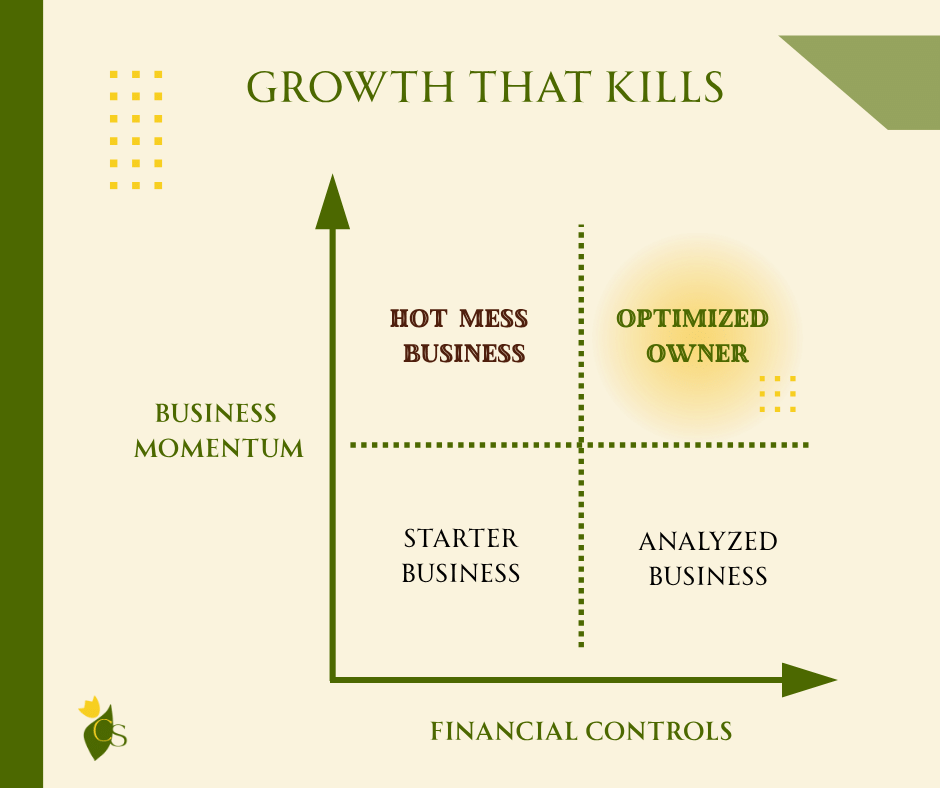
Growth That Kills is a phenomenon where a business undergo considerable revenue growth meanwhile, its underlying financial health degrades due to mismanaged costs, working capital strain, or operational inefficiencies.
TLDR;
- Rapid scaling without adequate preparation can trigger severe financial distress, even as top-line revenue rises.
- Business owners must align the development of their operating model, financial controls, and organizational structure with sales growth.
- Ignoring early warning signs of “growth that kills” leads to loss of control, eroding profitability, and potential insolvency.
Why Can Growth Be Dangerous for a Company?
Unchecked growth becomes a liability when it outpaces organizational capacity.
Prioritizing sales volume over operational readiness strains infrastructure, degrades the customer experience, and creates internal friction. Furthermore, revenue expansion without matching profitability only masks deep-grained systemic flaws. As operations scale, working capital demands surge—leaving unprepared companies highly vulnerable to liquidity crunches. True scalability requires disciplined focus; reckless expansion merely dilutes resources and distracts from high-margin, strategic priorities.
What Are the Signs of “Growth That Kills”?
- Revenue growth is not accompanied by a proportional increase in net profit, leading to declining profit margins. This may stem from unmonitored operational overhead or aggressive pricing strategies that dilute margins.
- A persistent working capital deficit. Even with strong sales numbers, the company might struggle to cover current liabilities, leading to delayed vendor payments or payroll bottlenecks. This indicates that growth is being funded by rapidly burning through internal cash reserves.
- Operational chaos. Processes that functioned smoothly for a smaller setup become ineffective, bottlenecks multiply, error rates spike, delivery timelines stretch, and employee burnout peaks. This indicates that organizational structure and operating workflows are failing to keep pace with growth.
Questions the owner should ask
- What is the trajectory of net profit relative to top-line revenue? Is profit growing in tandem with sales, or are margins deteriorating?
- Do we have sufficient working capital to sustain our current growth rate? What are our cash flow projections for the next 6 to 12 months?
- Where are the weakest bottlenecks in our operations limiting further scaling? Is there a plan to streamline or automate them?
- How efficiently are our core assets (equipment, facilities) utilized as volume increases? Are we operating beyond sustainable capacity?
- Do our current organizational structure and team skill sets align with our strategic growth goals? Are our leaders prepared to handle a larger operational footprint?
If you’re unsure of your financial status and health, fill out our Discovery Form for a free consultation on how we can clean-up, catch-up or structure your books to provide you with the data you need to make the right decisions.
Proactive is much cheaper than reactive!
Prevention and maintenance is key! We offer monthly professional bookkeeping services to help you remain confident, compliant, and focused on core business objectives.
Need Clarity on Your Own Financials?
Stop guessing and start making confident decisions. Complete our quick, guided Discovery Form to align on your bookkeeping needs and schedule a personalized Discovery Call.
Fill Out Our Discovery Form
Written by Mai Sosa
Owner & Faithful Bookkeeper at Covenant Solutions Group
Mai helps small business owners increase profits by optimizing their bookkeeping, untangling backlogged records, and turning confusing financial data into clear, actionable roadmaps for growth.